
Written by the AfroHairClinicTurkey editorial team, drawing on the clinical experience of our medical team · Last updated September 17, 2026 · How we write and check this
Most pages about shock loss answer a question about timing. The question people actually ask, in forums and in our own consultations, is different: will I come out of this with less hair than I went in with? This page answers that one. Where the honest answer is that nobody knows, it says so.
What shock loss is, and what it is not
Two different things shed after a hair transplant and they are easy to confuse.
The first is expected and happens to almost everyone: transplanted hairs typically shed within days of the operation and may take several months to regrow. Hair around the donor or recipient site can shed as well — shock loss — and this is transient; new hairs typically appear after three to six months, with grafts monitored over the following six to twelve months until they have fully matured. This is the general post-operative timeline and was not established specifically on Afro-textured hair[1]
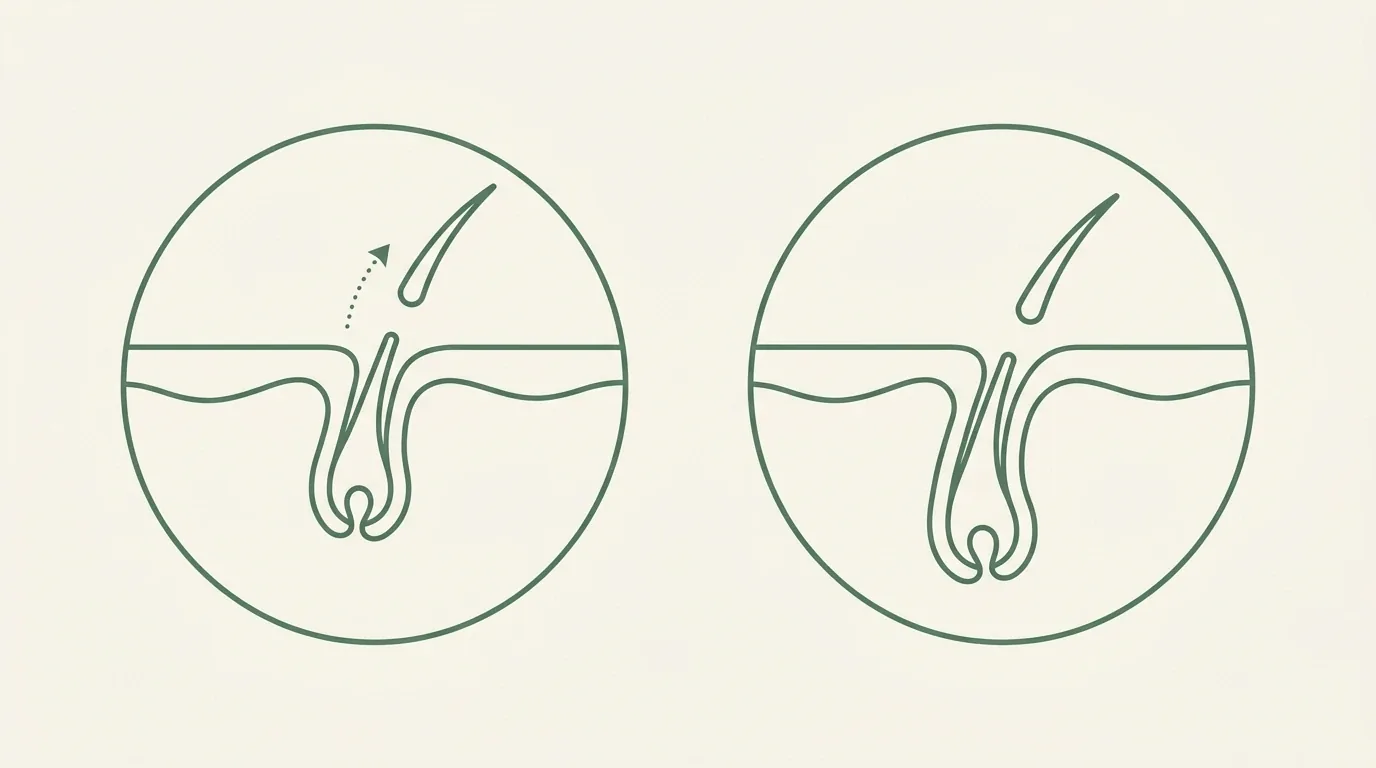
Shock loss is the second thing. It is the hair that was already growing there — your own native hair, in and around the area that was operated on — shedding in response to the surgery. Doctors call it post-operative telogen effluvium: the follicles are pushed out of their growing phase into their resting phase early, and the hair falls. The follicle itself is usually still there.
That distinction matters because the two have different answers. The first is a certainty with a known ending. The second is neither.
How often it happens
We are going to give you a range rather than a number, and we want to explain why before we give it, because the range is wide enough to look evasive.
A 2026 review of complications in follicular unit excision reports that the incidence of shedding at the recipient site varies widely between studies, ranging from 0.15 to 15 percent. The studies inside that range counted in different ways: one single-surgeon record of 2,896 operations noted it in three patients, while a 621-patient series that looked for it specifically found it in 23.[2,3,4,5]
A hundredfold spread is not the sort of thing a clinic usually prints. It is, however, what the published record actually contains, and the reason for it is not that one study is wrong. It is that they counted differently.
| Study | Who was counted | Recipient-area shedding | How it was counted |
|---|---|---|---|
| Garg & Garg, 2021[4] | 2,896 patients, one surgeon, ten years | 3 patients | Complications recorded as patients raised them |
| Okochi et al., 2024[3] | 621 patients, one centre, Japan | 23 patients | Shock loss looked for specifically |
A surgeon writing down the complaints his patients bring him will record fewer cases than a team examining six hundred scalps looking for the thing. Neither is dishonest. It means the low figure and the high figure are answers to slightly different questions, and that anyone quoting one of them at you as the rate is telling you something the evidence does not support.
When it starts
A 2026 review of complications in follicular unit excision reports that shedding at the recipient site typically occurs within two to eight weeks after surgery, with regrowth usually beginning around three months afterwards.[2,6]
Every competing page we read gives that window and stops there. It is the right central answer and it is too narrow to be the whole one, in both directions.
Earlier than the window: A series of 28 patients described shedding that began one to three days after surgery in a linear pattern, associated with dense-pack grafting at the receding temples. The authors suggest it could be the result of dense packing causing reduced oxygen supply around the recipient area and loss of miniaturised hairs there, and report that these effects were fully reversed in three months.[7] One to three days is not two to eight weeks. A patient told to expect nothing for a fortnight, who then watches a line of hair go on day two, has been given a window narrow enough to frighten them.
Longer than the window: In the two biopsy-confirmed cases of localized telogen effluvium after hair transplantation reported in Annals of Dermatology in 2018, shedding began three to four weeks after surgery, no treatment was given, and both patients had fully recovered within ten months.[6] Ten months is a great deal longer than the three-month mark quoted almost everywhere, and those two patients were biopsied, so there is no doubt about what they had.
On patient forums people describe shedding that began at three, five, even seven months. We have not found a study that covers those cases, which means we cannot tell you how common they are — only that the neat window you will be quoted elsewhere does not have room for them.
Does it grow back?
This is the question, and we are not going to give you a cleaner answer than the evidence supports. There are three published answers and they point in different directions.
Two say yes, and they counted. The two biopsied patients in the 2018 case report recovered completely without any treatment. The twenty-eight patients in the 2023 series — whose shedding specifically involved miniaturised hairs — were fully reversed at three months. Both are cited above.
One says not always. A 2026 review of complications in this surgery states that a permanent reduction in native hair density may occur, particularly in follicles nearing the end of their growth cycle or already miniaturised.
We followed that last sentence to its source
It matters more than the others, because miniaturised follicles are exactly what a lot of our patients have. So we checked what it rests on.
The review cites one reference for it: a 2013 review chapter on complications in hair restoration surgery. We read that chapter’s abstract. It is about preventable complications in general and reports no measurement of permanent shock loss. We could not find, anywhere, a study that counted how often this happens.
So the warning is expert opinion rather than a measurement. That does not make it wrong — experienced surgeons see things the literature has not caught up with, and this is the kind of thing that would be hard to measure. It does mean we will not repeat it to you as a fact, and it means the honest answer to does it grow back is: usually, in the cases anyone has published; not certainly; and nobody has measured the exception.
Under this site’s own rules a medical claim needs a study that measured the thing, not a review restating another review. This one did not pass, so it is not published as a claim. It is recorded as an open question instead.
Who it happens to most
A 2026 review of complications in follicular unit excision states that female sex has been identified as a major risk factor for shedding at the recipient site, with older age further increasing susceptibility among women.[2,3]
In a single-centre retrospective series of 621 follicular unit excision patients in Japan, 23 developed temporary shedding at the recipient site: 9 of the 554 men and 14 of the 67 women. Sex was the only risk factor the study identified, with an odds ratio of 30.18 and a 95 percent confidence interval of 9.43 to 96.55.[3]
Read that carefully, because it is easy to over-read. Sixty-seven women is a small group, the confidence interval is correspondingly wide, and the cohort was Japanese. It tells you a direction, not your odds. No study has produced a percentage for women, and none has looked separately at the conditions that bring most of our patients to surgery.
What nobody has measured, and why it is this clinic saying so
We searched PubMed on 17 September 2026 for telogen effluvium together with hair transplantation and read every record it returned. None of them reports how often shedding after surgery occurs in Afro-textured hair, and none analyses traction alopecia or CCCA patients separately. The 2026 review of follicular unit excision complications does not mention Afro-textured hair either.
Every cohort above that carried a denominator was East Asian, South Asian, or did not state hair type at all. We looked for an Afro-textured figure and there is not one. The query, the date and the databases we searched are recorded in our evidence library, including what we did not search, so that anyone who finds a paper we missed can show us.
This next part is our reasoning, not a citation
The 2026 review says the follicles at risk of not coming back are those already miniaturised. A hairline damaged by traction alopecia is substantially made of exactly those — fine, weakened hairs at the margin that have been under tension for years. Putting those two facts side by side suggests the question matters more for our patients than for the cohorts that have been studied.
We want to be precise about what that is. It is an inference. The review does not say it. No one has tested it. We raise it because it would be strange to notice and not mention, and we label it because presenting it as established would be exactly the thing we built this site to avoid. If you see this argument made anywhere without that label, treat it the same way.
There is a second, related unknown: whether shedding in a scalp affected by CCCA can be told apart from the condition itself becoming active again. Those need different responses, and we have found nothing published on distinguishing them. We went looking properly and wrote up what is and is not known on a page of its own — shedding or a flare? — including a 2025 tool that scores CCCA activity and a mistake we made while researching it.
The donor area — the back of your head
Almost everything above is about the area that receives the grafts. Your own hair can also shed where the grafts were taken from, and that is a different problem with a much thinner evidence base.
The true incidence of shedding in the donor area after follicular unit excision is unknown. A 2026 review states that only isolated case reports and small series have been published, and the authors of a 2023 case report say the same.[8]
You will find pages quoting five to ten per cent here. We could not trace that figure to anything at all.
It can look like something much more frightening
Patchy hair loss in the donor area after follicular unit extraction can resemble alopecia areata both clinically and on trichoscopy, where black dots, exclamation-mark hairs and the coudability sign were all present. On biopsy the picture was different: dilated capillaries around the follicles, mucin deposition around the arrector muscles, dermal oedema and only a few lymphocytes, resembling a healing wound. The authors conclude that it should not be confused with alopecia areata.[9]
This is the single most useful thing on this page for somebody three weeks post-surgery. A round bald patch at the back of the head, and a trichoscopy image that matches every picture of alopecia areata online, is a reasonable reason to panic — and in that series none of the patients had any history of alopecia areata. What separated the two was the biopsy, and the surgical timeline. If this happens to you, that is the conversation to have with a dermatologist, rather than one about autoimmune disease.
In a series of four men who had between 2,200 and 3,500 grafts extracted, patches of non-scarring hair loss appeared in the donor area two to three weeks after the procedure, and the hair pull test was positive in all four.[9]
We have to correct something we were going to tell you
Every page about this, and an earlier draft of this one, says donor shedding resolves by itself. The series with the most patients in it does not say that.
In the series of four patients with donor-area patches, all four were treated with intralesional triamcinolone and all four showed moderate to good improvement. The report does not state that the hair returned completely.[9]
Be careful how you read that in both directions. All four were treated, so the series cannot tell you what would have happened without the injections — it is not evidence that the hair would not have come back on its own. And in a separate single-patient report, the shedding did settle almost completely within a month. What it does mean is that “it resolves on its own” is a sentence with less behind it than the confidence with which it is usually said.
Even the name is unsettled
Although post-transplant shedding is usually named telogen effluvium, the authors of a four-case series with biopsies hypothesise that compromised blood supply and trauma to the existing hairs may produce an anagen effluvium instead. A 2026 review takes a similar view, suggesting donor-area shedding probably spans both phases rather than being a pure telogen process.[9]
This changes nothing about what you should do. We mention it because a field that has not settled which phase of the hair cycle it is looking at is a field that should be quoting you percentages more carefully than it does.
One paper we tried to get and could not
The largest donor-area series in print is twelve patients, published in 2021. We went after it properly: the publisher’s paywall, no open copy recorded anywhere, no abstract in any index. The only text we could retrieve was the article’s introduction, which ends at the point where it promises to describe the twelve patients and does not describe them.
So it stays in our library marked unread, and nothing on this page rests on it. An introduction is not findings, and a title is not a citation. What that search did produce was the four-case series above, which is free to read and is where most of this section now comes from.
Everything we have and have not been able to read is listed in our evidence library. If you have institutional access to Dermatologic Surgery and can send us that paper, we will read it and update this page.
If what you are seeing is not hair leaving but an uneven surface — bumps at the graft sites, dimples, rows — that is a different thing with a different timeline, on cobblestoning, pitting and repair.
What we will not tell you
- That shock loss will not happen to you. We cannot know that, and neither can anyone who tells you otherwise before examining you.
- A percentage for your own risk. The published figures come from cohorts you are not in.
- That everything always grows back. Two published series say it did in their patients. One review warns it may not in some follicles. That is not the same as a guarantee.
- That a drug or a treatment will prevent it. In the case report we read, both patients recovered with no treatment at all.
- A figure for Afro-textured hair. It does not exist yet.
What to ask before you book — anywhere
These are the questions that separate a surgeon who has thought about this from one who has a reassuring script. Ask them of us too.
- At what density are you implanting, and why that number? Higher density has been proposed as a contributing factor. A surgeon who has never considered the trade-off will treat this as a strange question.
- How much of the hair at risk here is already miniaturised? This is the group the literature is least reassuring about. It requires them to have looked closely.
- What will you photograph on the day, and will I get copies? The 2023 series recommends photographing transplanted and untransplanted areas immediately, precisely so that shedding can later be told apart from graft failure.
- If I shed at week three, what do we do, and what will it cost me? The answer should be a plan, not reassurance.
- Show me the source. For any number you are given, ask which study it came from. Every figure on this page links to one.
- Am I even a candidate? Six questions worth answering before any of this matters are on our before you book page.
If you want these questions answered about your own scalp rather than in general, send them to us and we will answer them in writing. Our full record of what we can and cannot evidence is on the verification page.
Clinical references
- Goldin J, Zito PM. Hair Transplantation. In: StatPearls [Internet]. Treasure Island (FL): StatPearls Publishing; updated 2 August 2025. Bookshelf ID NBK547740. PMID 31613520. view source →
- Romera de Blas C, Vega Díez D, Ricart Vayá JM, Gómez Zubiaur A. Complications in follicular unit excision hair transplantation. Frontiers in Medicine. 2026. doi:10.3389/fmed.2026.1750989 view source →
- Okochi H, Onda M, Momosawa A, Okochi M. An Analysis of Risk Factors of Recipient Site Temporary Effluvium After Follicular Unit Excision: A Single-Center Retrospective Study. Aesthetic Plast Surg. 2024;48(7):1258-1263. view source →
- Garg AK, Garg S. Complications of Hair Transplant Procedures-Causes and Management. Indian J Plast Surg. 2021;54(4):477-482. view source →
- Liu RH, Xu LJ, McCarty JC, Xiao R, Chen JX, Lee LN. A Scoping Review on Complications in Modern Hair Transplantation: More than Just Splitting Hairs. Aesthetic Plast Surg. 2025;49(3):585-595. view source →
- Loh SH, Lew BL, Sim WY. Localized Telogen Effluvium Following Hair Transplantation. Ann Dermatol. 2018;30(2):214-217. view source →
- Mir-Bonafe JM, Mir-Bonafe JF, Mir-Bonafe M. Immediate-Onset Linear Effluvium Associated With High-Density Hair Transplantation: A Series of 28 Cases. Actas Dermosifiliogr. 2023;114(5):T437-T441. view source →
- Guerrero-Gonzalez GA, Gonzalez-Martinez G, Valdez-Zertuche JA. Localized Donor Area Acute Telogen Effluvium following Follicular Unit Extraction: Key Trichoscopic Findings. Skin Appendage Disord. 2023;9(5):377-379. view source →
- Kerure AS, Agrawal SM, Dhurat R, Ginzburg A. Donor Area Acute Effluvium following Follicular Unit Extraction-Trichoscopic Simulator of Alopecia Areata: Series of Four Cases. J Cutan Aesthet Surg. 2020;13(1):31-34. view source →
References are checked on the dates recorded in our evidence library. If a source has been superseded, tell us and we will update it.