
Written by the AfroHairClinicTurkey editorial team, drawing on the clinical experience of our medical team · Last updated September 17, 2026 · How we write and check this
Most pages about traction alopecia surgery are about the hair that gets put in. This one is about the hair you still have — the thin line of edges along your hairline and temples that survived everything. What happens to those, once grafts are placed either side of them?
We went looking for the answer before writing this, and the honest finding is that nobody has published one. Not the American Academy of Dermatology, not DermNet, not StatPearls, not the large clinic sites. Every one of them uses those edges to make the diagnosis and then stops talking about them.
Those edges are not a detail. They are your diagnosis.
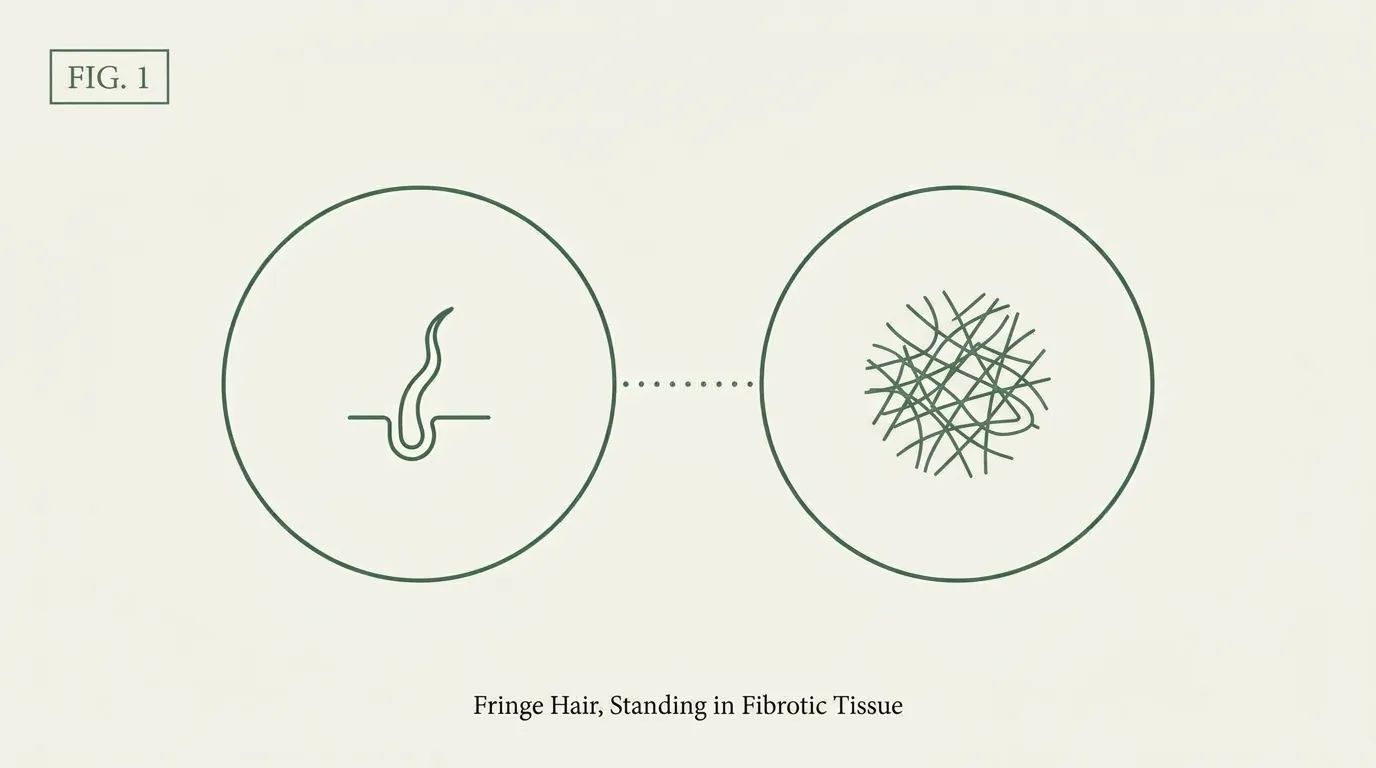
In the series that named the fringe sign, 35 of 41 women with traction alopecia had a retained strip of hairs along the frontal or temporal rim, and every woman whose traction involved the marginal hairline had one. A later review describes the preservation of that fringe as a clue that distinguishes traction alopecia from frontal fibrosing alopecia, where it is lost.[1,2]
Doctors call it the fringe sign. If your hairline has receded but a rim of hair remains in front of the bald band, that pattern is what tells a dermatologist this is traction and not something else. In frontal fibrosing alopecia, a different and more aggressive condition, that rim is gone.
And they are standing in scarred tissue
Fourteen biopsies from that series were available for review. Fibrotic fibrous tracts were present in all of them, and a decrease in terminal hairs in all of them, alongside retained sebaceous glands in all, an increase in vellus-sized hairs in half, and sparse lymphocytic inflammation in just over half.[1]
Read that carefully in both directions. It tells you the skin at the margin has changed — it does not tell you a graft will fail there, because that study did not transplant anybody. It measured what the tissue looks like, nothing more.
Before anything else
A review of traction alopecia states that there is currently no cure, and that in its later stages the disease may progress into an irreversible scarring alopecia if traumatic hairstyling continues without appropriate intervention.[2]
Surgery is not a treatment for traction alopecia. It is a repair carried out on damage the condition has already done, while the condition itself remains whatever it was. Every sentence below sits inside that frame.
How much is actually known about this operation
We searched PubMed for the exact pair of terms and read every record it returned. There are eleven. Two of them are reports of transplanting a scalp traction alopecia: one from 1986 and one from 2005.

The only outcome figure that exists, and why it is not a claim here
The 2005 report describes a 23-year-old woman who had worn an extremely tight ponytail daily for five years and developed scarring alopecia at both temples. She had one session of micro- and mini-grafting. At one year, 90 to 95 per cent of the transplanted hair had survived.
That is the entire quantitative evidence base for this operation. One woman. One year. Her hair type is not recorded anywhere.
We could not read that paper. It has no abstract in any index, and its one open copy refuses every request. Everything above reaches us through a 2018 review that did read it. Under this site’s own rules a figure that comes to us through somebody else’s summary is not published as a sourced claim, so it is not one — it is shown here as a chain, with the weak link visible. The 1986 report gives no outcome at all.
This is the third page on this site where the decisive number turned out to be sitting behind a door. That pattern is worth knowing about when anyone quotes you a success rate.
The closest thing to a long-term answer comes from a different disease
A 2026 systematic review of hair transplantation in lichen planopilaris and frontal fibrosing alopecia, covering 13 studies and 113 patients, reported graft survival of 80 to 100 percent at six to twelve months, 71 to 100 percent up to twenty-four months, and below 41 percent after the second year. The authors identified no prospective studies or clinical trials, and noted a clear decline in graft survival after the second year.[3,4]
That is lichen planopilaris and frontal fibrosing alopecia — scarring conditions of the hairline that are not traction alopecia. The mechanism is different: those are ongoing inflammatory diseases, while traction is an outside force. You cannot take that curve as your own.
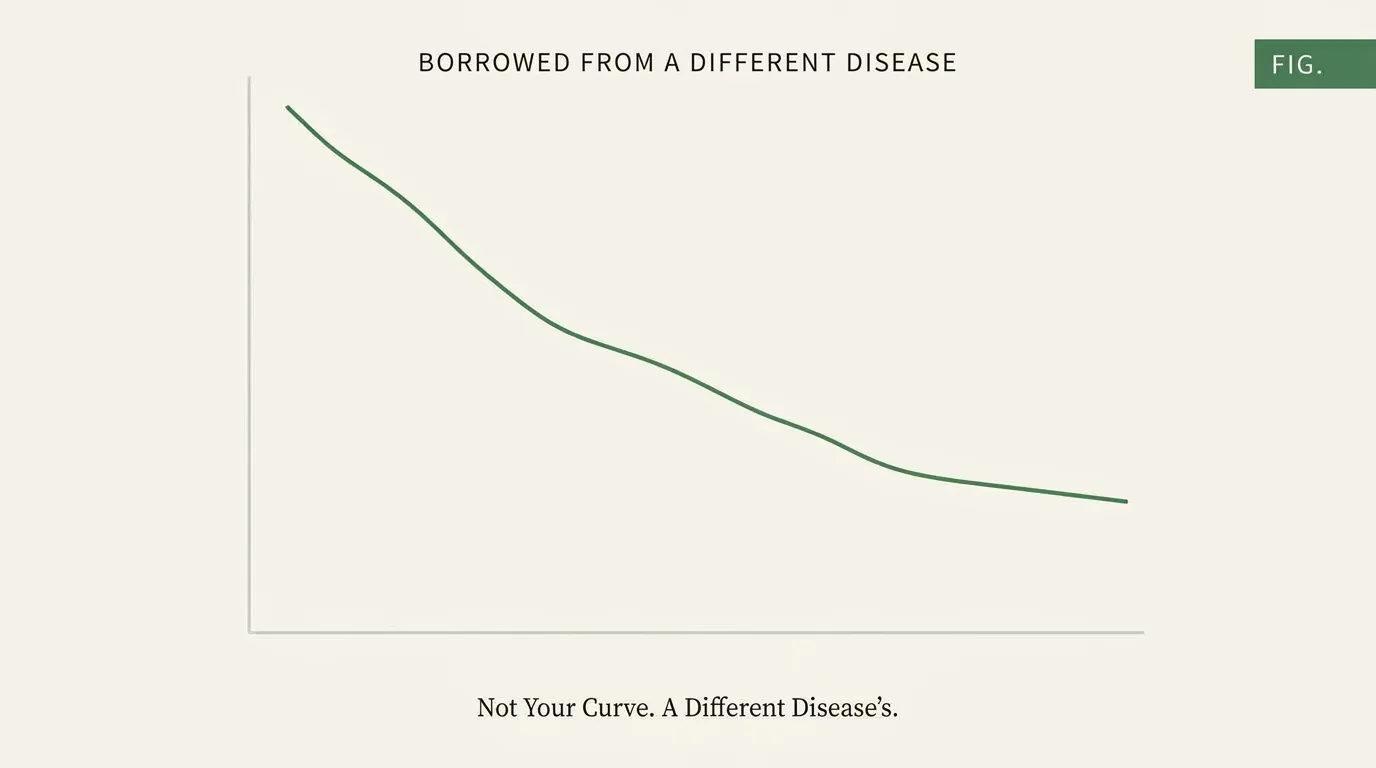
We publish it because it is the only picture anyone has of what happens to grafts placed in a scarred hairline over several years, and because the alternative — the unsourced “80 per cent success” on almost every competing page — tells you less while sounding like more. Whether traction alopecia grafts behave like that is genuinely unknown. We found no evidence either way and we are not going to invent a direction.
What the published curves look like side by side, and why the first-year figure is the one every clinic shows, is on how long a hair transplant lasts.
And nobody agrees how long to wait first
In that same review, transplantation was performed on patients with no clinically active disease in ten of the studies, covering 101 patients. The length of time the disease had been quiet before surgery varied widely between studies, ranging from none at all to sixty months.[3]
Zero to sixty months is not a range of opinion. It is the absence of a rule. If you are quoted a waiting period as though it were settled, ask where the number comes from.
“Can I wear braids again?”
This is the question women actually ask. Reading about fourteen hundred comments under patients’ own videos, it comes up more than anything else — wigs, weaves, headbands, when, how soon — including from women saying they are in surgery tomorrow. One asks simply whether she can wear a wig after. Another asks whether it is safe at a month or two.
The honest answer has two halves, and most pages give neither.
The first half is that tension is the cause, and a graft is not immune to it. You will find it written — including on sites aimed squarely at Black women — that transplanted follicles are resistant to traction alopecia. We can find nothing supporting that, and it does not follow: traction is a mechanical force applied from outside, and a transplanted hair sits in the same scalp under the same pull. Treat that reassurance as marketing.
The second half is that “never again” is not an answer anybody can live with, and pretending otherwise just means women do it without telling their surgeon. What is missing from every page we read is the thing that would actually help: a plan for tension — which styles pull on the margin and which do not, how long, how often, and what to watch for. We cannot hand you that plan from the literature, because the literature does not contain it. We can tell you it is the right conversation to demand.
You can watch the argument happening in public. One woman who documented her transplant is wearing box braids two years later, and her own viewers are alarmed on her behalf. Nobody in that thread has a source. Neither does anyone else.
The question nobody is asking
In all those comments, women ask how long the grafts last, whether the loss comes back, whether the donor area recovers, and whether they can braid again. Not one of them asks what happens to the edges they still have.
We do not think that is because it does not matter. We think it is because nobody has told them it is a question. The closest anyone comes is a woman recalling that she can no longer style her baby hairs, and saying she was devastated for months.
This next part is our reasoning, not a citation
Three things are separately documented. Your surviving rim of edges is what the diagnosis is made from. The tissue it stands in showed fibrotic tracts in every biopsy examined in the study that named it. And hair that was already growing can shed after a transplant — we set out what is known about that on our shock loss page, including a review’s warning that the loss may be permanent in follicles that are already miniaturised.
Your edges are, almost by definition, fine and weakened hairs. Putting those three facts beside each other suggests the surviving fringe is exactly the hair most exposed when grafts go in around it.
We want to be exact. No study has tested this. No paper makes this argument. It is an inference from three unrelated findings, and it could be wrong — those hairs might be no more vulnerable than any others. We raise it because it would be strange to notice and say nothing, and we label it because presenting it as established would be the thing this whole site exists to avoid.
What to do with it: ask your surgeon directly what the plan is for the hairs you still have, and ask for them to be photographed separately before surgery. If nobody photographs them, nobody can tell you afterwards what happened to them — which is one reason this question has no published answer.
Before surgery: a scarred edge is not proof of traction
In a review of 15 patients with scarring alopecia of the scalp margin, six gave a history of relaxing or straightening their hair, six denied hair care practices sufficient to cause traction alopecia, and in three the history was unknown. The author reports that scarring at the margin is difficult to diagnose both clinically and histologically, and that the absence of a history of severe traction in half the patients casts doubt on whether traction is the only cause.[5]
Half of those patients did not have a history that explained it. Some marginal hair loss that looks like traction is frontal fibrosing alopecia or another scarring condition, and those change the decision entirely. The fringe helps: in traction it is retained, in frontal fibrosing alopecia it is lost. It is not proof on its own.
Why there is no long-term data
In a retrospective review of 216 patients with traction alopecia at a single institution in the Bronx, 98.6 percent of whom were women and 72.7 percent Black or African American, 49.1 percent attended a follow-up visit. Of those who did, 42.5 percent noted improvement in hair loss or symptoms across all visits.[6]
That is part of the answer to a question you might reasonably be asking by now: if this operation has been done for forty years, why does nobody know how it turns out? Five-year outcomes cannot be measured in a population that mostly does not come back, and follow-up costs the patient time and money for a visit that often produces no new answer. A clinic that wants to know its own results has to build follow-up in and pay for it, not hope for it.
What we will not tell you
- A success rate for traction alopecia transplants. There is one published patient. No honest arithmetic starts there.
- How long the grafts will last. The only multi-year curve anyone has is from a different disease, and we will not pass it off as yours.
- That transplanted hair resists traction. We can find nothing supporting that, and the mechanism argues against it.
- That your surviving edges are safe, or that they are doomed. Nobody has measured it.
- A date when you can braid again as though it were established. It is not.
- That surgery treats traction alopecia. There is no cure; surgery is a repair.
What to ask — here or anywhere
- What is your plan for the hairs I still have? The retained fringe. If this has not been considered, you will hear it immediately.
- Will you photograph my remaining edges separately, and will I get those photographs? Without them nobody can tell you later what changed.
- Are you sure this is traction and not something else? Ask what rules out frontal fibrosing alopecia, and whether a biopsy is warranted.
- What is my styling plan afterwards — not just when, but what? A date alone is not a plan. Ask which styles put tension on the margin.
- How many traction alopecia patients have you operated on, and how are they now? Compare the answer with one, which is the published world. A clinic with real numbers of its own is worth more here than the literature.
- Show me the source. For any figure you are quoted, ask which study. Every number on this page links to one.
- Am I a candidate at all? Our before you book page asks the six questions that decide it, including whether the tension has actually stopped.
If you want these answered about your own hairline rather than in general, send them to us and we will reply in writing, including where the answer is that nobody knows. Background reading: traction alopecia, shock loss, and shedding or a flare. What we can and cannot evidence is on the verification page.
Clinical references
- Samrao A, Price VH, Zedek D, Mirmirani P. The "Fringe Sign" - A useful clinical finding in traction alopecia of the marginal hair line. Dermatol Online J. 2011;17(11):1. view source →
- Billero V, Miteva M. Traction alopecia: the root of the problem. Clin Cosmet Investig Dermatol. 2018;11:149-159. view source →
- Palacios-Diaz RD, Lasheras-Perez MA. Systematic review of efficacy of hair transplantation in patients with classic lichen planopilaris and frontal fibrosing alopecia: revisiting the current evidence. An Bras Dermatol. 2026;101(5):501426. view source →
- Daruwalla SB, Dhurat R, Ghate S, Bhatt K. Long-Term Utility of Follicular Unit Excision in Lichen Planopilaris-Correlation of Graft Survival With Histopathological and Ultrasound Biomicroscopic Parameters. Dermatol Surg. 2021;47(9):1243-1248. view source →
- Goldberg LJ. Cicatricial marginal alopecia: is it all traction? Br J Dermatol. 2009;160(1):62-68. view source →
- Balazic E, Hawkins K, Choi J, Konisky H. Traction alopecia: assessing the presentation, management and outcomes in a diverse urban population. Clin Exp Dermatol. 2023;48(9):1030-1031. view source →
References are checked on the dates recorded in our evidence library. If a source has been superseded, tell us and we will update it.